

Commercial Hood Cleaning in Hobe Sound, FL
Hobe Sound is a small, high-end enclave, and that changes what a hood cleaning has to be. The independent restaurants on Bridge Road and the private clubs and estates serving Jupiter Island run on reputation. In a community this tight, a smoke complaint or a failed inspection travels fast. So the work here stays quiet, clean, and low-disruption. We clean the entire exhaust system to fire-code standard with the discretion these kitchens expect, and we check the rooftop fan for the Intracoastal salt-air wear the barrier island brings on.
Why Hobe Sound Kitchens Need a White-Glove Approach
In an enclave this small and this upscale, the priorities shift toward discretion and reputation:
- Low-disruption, discreet service: reputation-sensitive Bridge Road kitchens and private-club dining rooms expect spotless, odor-free operations. We schedule and work to stay out of your guests' way.
- Martin County's annual mandate: the county ordinance requires an annual fire and life-safety inspection of every commercial occupancy. Even a low-volume upscale kitchen here gets a fire-marshal visit and needs a current, dated cleaning certificate ready.
- Barrier-island salt air: these rooftop fans sit along the Intracoastal Waterway and Jupiter Island, where coastal salt corrodes housings, fasteners, and bearings. We check the fan for corrosion and belt wear on top of grease.
- Martin County inspectors: your authority is Martin County Fire Rescue's Fire Prevention division in Stuart, not the St. Lucie County Fire District or Indian River County. The certificate has to be ready for that office specifically.
What an NFPA 96 Hood Cleaning Covers
NFPA 96 is the national fire-safety standard for commercial kitchen exhaust. It requires grease to be removed down to bare metal across the entire system, including the parts you cannot see. Our commercial kitchen hood cleaning reaches every section grease can travel through:
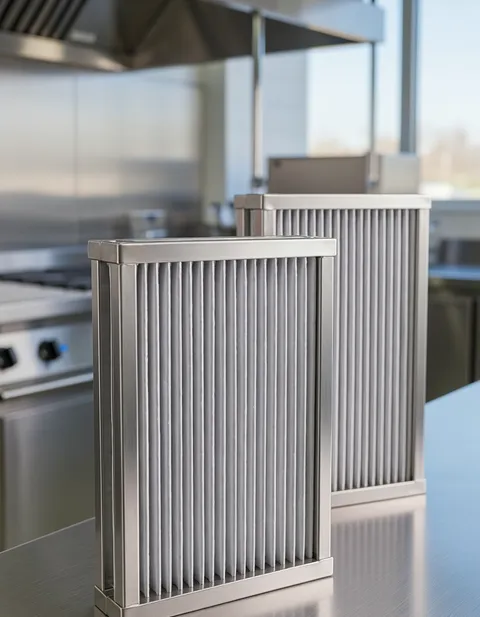
- Hood canopy & baffle filters: scraped and hot-washed, with the filters pulled and soaked in degreaser.
- Plenum & access panels: the chamber behind the filters where grease pools. We open it and clean it, never just spray it.
- Vertical & horizontal ductwork: the hidden run between the hood and the fan, where most grease fires start.
- Rooftop exhaust fan: hinged back, degreased, and checked for the coastal corrosion, belt wear, and balance this oceanfront setting brings on.
- Rooftop grease containment: grease boxes and pads cleaned or replaced so runoff never reaches your roof membrane.
Our Cleaning Process, Step by Step
- Inspect the full system from hood to fan and measure grease depth against the code thresholds with a grease gauge.
- Cover and protect your cooking equipment, then remove the baffle filters to soak in degreasing solution.
- Scrape and hot-wash the hood canopy interior and underside, working top-down so grease drips out, not onto your line.
- Open the plenum and access panels and clean the ductwork along its full length.
- Hinge open the rooftop fan, degrease the housing and blades, and check the belt, balance, and salt-air corrosion.
- Clean or replace rooftop grease containment, then reinstall the filters and wipe down the exterior.
- Document the work and apply a dated compliance service sticker for your inspector.
Serving Hobe Sound's Independent & Club Kitchens
Hobe Sound's dining is concentrated, independent, and tied to the barrier-island clientele rather than chain corridors. We clean hoods for the kitchens that define the area:
- Bridge Road downtown: the independent, reputation-driven restaurants in the historic shopping district
- Dixie Highway corridor: neighborhood and mainland Hobe Sound kitchens
- Jupiter Island: private clubs and estate kitchens across the South Jupiter Narrows
- Gomez / mainland: smaller community and roadside operators
The island and snowbird population surges in winter and thins in summer, so club and enclave kitchens cycle between busy and quiet. We time cleanings to the season rather than a flat calendar.
How Often Your Kitchen Should Be Cleaned
The fire code sets your cleaning frequency by how hard you cook, and Martin County Fire Rescue can require more based on what its annual inspection finds:
- Monthly: solid-fuel cooking (wood, charcoal) and high-volume wok lines
- Quarterly: high-volume frying, grilling, and 24-hour kitchens
- Semi-annually: moderate-volume sit-down restaurants
- Annually: low-volume or seasonal enclave and club kitchens
What You Get After Every Visit
- A bare-metal clean: verified deep at the access panels, where grease hides.
- A written report with photos: before-and-after proof for your records and your insurer.
- A dated compliance sticker: the tag the county fire marshal looks for at the annual inspection, signed and dated.
Kitchen exhaust systems are behind roughly a third of all restaurant fires. Nearly all of them are preventable with regular cleaning. Most code-compliant cleanings start around a $400 to $600 minimum and scale with the size of your system, how heavy the grease load is, and how easy the fan is to reach. Request a free quote and we will give you a clear breakdown and discreet, low-disruption service built for kitchens here in Hobe Sound.
Request a Free Quote